For creative professionals, optimizing workflow and maximizing output are constant objectives. While traditional project management often focuses on linear timelines, an alternative perspective considers the cyclical influence of lunar phases on human energy, focus, and ideation. This approach doesn't rely on mystical interpretations but rather on observing patterns of ebb and flow, associating specific lunar stages with particular mental states conducive to different creative tasks. Understanding these cycles can provide a framework for scheduling intensive ideation, focused execution, critical review, or necessary periods of rest and introspection. By aligning creative endeavors with the prevailing energetic signature of each moon phase, individuals and teams can potentially enhance productivity, reduce burnout, and foster a more intuitive, sustainable creative process. This guide outlines the most impactful moon phases for various creative activities, offering a practical lens through which to plan and execute projects.
How to Align Your Creative Process with Lunar Cycles
Integrating lunar awareness into a creative workflow involves recognizing the distinct energetic qualities each phase presents and then matching specific tasks to those qualities. This isn't about rigid adherence but rather about cultivating a deeper self-awareness and responsiveness to natural rhythms. Consider tracking your own energy levels and creative inclinations throughout a lunar month to identify personal correlations. For example, if you consistently find yourself more inclined towards brainstorming at the New Moon or refining details around the First Quarter, lean into those natural tendencies. The goal is to create a flexible framework that supports your innate creative flow, rather than imposing external deadlines that may conflict with your internal rhythm. This approach can help in proactive scheduling, ensuring that periods demanding high focus are met with peak mental clarity, and times requiring introspection are honored with space for reflection.
1. New Moon
The New Moon marks the beginning of a new lunar cycle, a period of darkness and quiet introspection. Energetically, it's associated with fresh starts, planting seeds, and setting intentions. For creative people, this phase is ideal for deep ideation, brainstorming new concepts, and envisioning the scope of future projects without the pressure of immediate execution. It’s a time to connect with your core purpose and define what you want to bring into existence.
Best for: Initial brainstorming, strategic planning, setting project intentions, concept development, vision boarding.
Pros: Fosters clarity of purpose, encourages uninhibited ideation, supports strategic foresight, perfect for sketching out big-picture ideas.
Cons: Not suitable for detailed execution or presenting unfinished work; energy levels may be lower, requiring more internal focus.
Verdict: Leverage the New Moon for foundational work and conceptualization. Use this quiet period to define your creative direction before the cycle gains momentum.
2. Early Waxing Crescent
Following the New Moon, the Waxing Crescent phase sees the first sliver of light return to the sky. This represents the initial emergence of ideas into action. It’s a period of gentle forward momentum, where the initial concepts from the New Moon begin to take tangible form. Energy levels are slowly increasing, making it suitable for preliminary research, gathering resources, and outlining the first steps of a project.
Best for: Preliminary research, outlining project structure, gathering inspiration, initial material collection, setting up project infrastructure.
Pros: Supports gradual progress, builds initial momentum, ideal for fact-finding and resource identification, encourages structured planning.
Cons: Still too early for significant execution or decision-making; focus might be broad rather than highly detailed.
Verdict: Use the Early Waxing Crescent to translate New Moon intentions into actionable steps and collect the necessary components for your creative work.
3. First Quarter
At the First Quarter, half of the moon is illuminated, signifying a point of decision and action. This phase often brings the first challenges or obstacles, requiring focused effort and commitment to overcome. For creatives, it's a powerful time for concentrated work, problem-solving, and pushing through initial resistance to bring ideas to life. Energy is building, lending itself to focused execution and overcoming creative blocks.
Best for: Focused execution, problem-solving, overcoming creative blocks, making critical design decisions, developing initial drafts.
Pros: High energy for concentrated work, supports decisive action, excellent for tackling difficult aspects of a project, builds resilience.
Cons: Can feel challenging as the first hurdles emerge; not ideal for passive reflection or broad ideation.
Verdict: The First Quarter is prime time for active creation and pushing past initial difficulties. Commit to significant progress on your project.
4. Late Waxing Gibbous
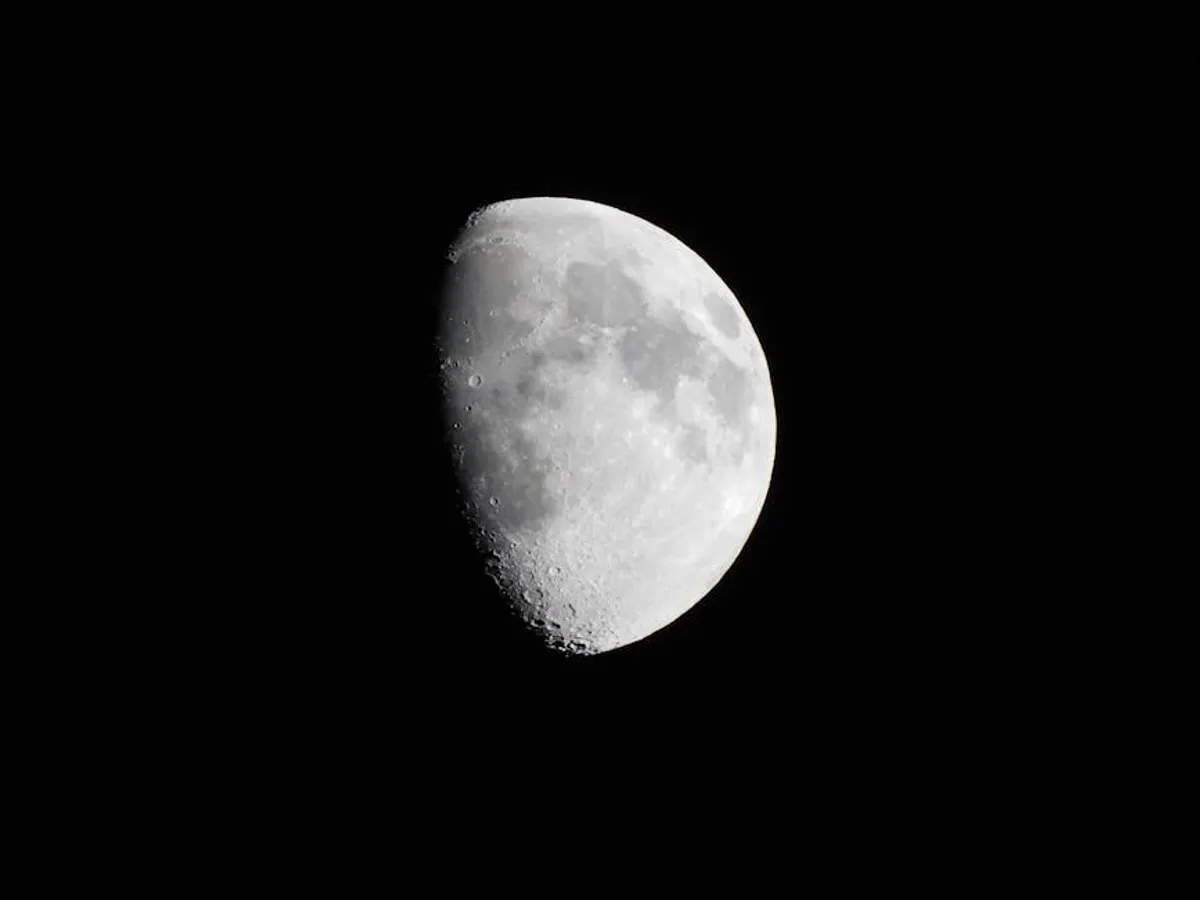
As the moon approaches fullness, the Waxing Gibbous phase is characterized by expansion, refinement, and a drive towards completion. Most of the moon is visible, reflecting a period of intense activity and detailed work. This is when creative projects take on their final form, requiring meticulous attention to detail, collaborative efforts, and a focus on perfecting the output before its culmination.
Best for: Refinement, detailed editing, collaboration, expanding on existing ideas, preparing for launch or presentation, quality assurance.
Pros: Supports meticulous work, excellent for collaborative efforts, enhances attention to detail, builds anticipation for project completion.
Cons: Can lead to perfectionism or overthinking if not managed; not the best time for entirely new directions.
Verdict: Leverage the Late Waxing Gibbous for polishing and perfecting your creative output. This is where the project truly shines before its public debut.
5. Full Moon
The Full Moon is the peak of the lunar cycle, a time of maximum illumination, culmination, and heightened energy. For creatives, this phase is often associated with peak inspiration, breakthroughs, and the successful completion or presentation of projects. It's a powerful time for sharing your work, receiving feedback, and celebrating achievements. Emotional intensity can be high, which can fuel passionate expression.
Best for: Project launches, presentations, public speaking, releasing finished work, celebrating milestones, peak creative breakthroughs.
Pros: High energy for impactful presentations, supports public recognition, ideal for receiving feedback, fosters a sense of completion and achievement.
Cons: Can lead to overstimulation or emotional overwhelm; not suitable for quiet, internal work or starting new complex projects.
Verdict: The Full Moon is your moment for impact and display. Use this energy to present, launch, or share your most polished creative endeavors.
6. Early Waning Gibbous
After the Full Moon, the Waning Gibbous phase begins, with the moon gradually decreasing in light. This period is ideal for reflection, analysis, and strategic review. For creatives, it's a time to assess the reception of your work, gather insights, and understand what worked well and what could be improved. It's a more analytical and evaluative phase, preparing for future adjustments.
Best for: Post-launch analysis, gathering feedback, reviewing project performance, strategic planning for future iterations, documenting lessons learned.
Pros: Supports objective evaluation, excellent for data interpretation, fosters learning and improvement, helps in refining future strategies.
Cons: Not a time for new creative output; can feel anticlimactic after the Full Moon's peak.
Verdict: Utilize the Early Waning Gibbous for critical assessment and learning. This phase is crucial for transforming experience into actionable knowledge.
7. Third Quarter
The Third Quarter moon is again half-illuminated, but this time the light is decreasing. This phase represents a turning point, a time for release and letting go of what no longer serves. For creative projects, it’s an opportune moment to prune unnecessary elements, make necessary course corrections, or even decide to abandon unworkable ideas. It's about streamlining and preparing for the next cycle.
Best for: Course correction, decluttering creative spaces, letting go of unworkable ideas, simplifying complex projects, strategic pivots.
Pros: Encourages decisive action on what to discard, supports efficiency, ideal for streamlining processes, helps clear mental and physical clutter.
Cons: Can involve difficult decisions or letting go of invested effort; not a time for expansion.
Verdict: Use the Third Quarter to ruthlessly edit and refine your creative process and projects, shedding anything that hinders future progress.
8. Late Waning Crescent (Balsamic Moon)
The Late Waning Crescent, often called the Balsamic Moon, is the final sliver of light before the New Moon. This is a period of deep rest, introspection, and spiritual cleansing. For creatives, it's a vital time for winding down, completing loose ends, and preparing for the next cycle of inspiration. It’s a low-energy phase, best suited for reflection, dreaming, and allowing new ideas to germinate subconsciously.
Best for: Deep rest, introspection, completing minor tasks, clearing your workspace, dream journaling, allowing new ideas to form subconsciously.
Pros: Essential for preventing burnout, fosters deep reflection, creates space for future inspiration, supports mental and emotional rejuvenation.
Cons: Very low energy for active creation or engagement; not suitable for demanding tasks or social interaction.
Verdict: Honor the Late Waning Crescent as a period of essential rest and quiet preparation. Allow yourself to recharge fully before the next creative surge.
9. Perigee Moon (Supermoon)
While not a distinct phase, the Perigee Moon occurs when the moon is closest to Earth in its orbit, often coinciding with a Full or New Moon. This proximity can amplify the energetic qualities of that phase, leading to heightened emotional intensity and, for many creatives, a surge of powerful, almost raw, inspiration. It's a time when ideas can feel more vivid and the drive to create more urgent.
Best for: Intense bursts of creative output, expressing strong emotions through art, tackling ambitious projects, deep dives into complex themes.
Pros: Amplified inspiration and emotional depth, supports powerful and impactful creative work, can lead to significant breakthroughs.
Cons: Can also amplify stress or emotional volatility; requires careful management of energy to avoid burnout.
Verdict: Leverage the Perigee Moon for impactful, emotionally resonant creative work, but be mindful of the potential for overwhelm.
10. Apogee Moon (Micromoon)
Conversely, the Apogee Moon occurs when the moon is furthest from Earth. This distance can be associated with a more detached, analytical, and objective perspective. For creatives, this period might be less about raw inspiration and more about intellectual clarity, structural analysis, and seeing the bigger picture from a distance. It's a good time for critical review, strategic planning, and dispassionate evaluation.
Best for: Objective analysis, strategic planning, critical review of ongoing projects, long-term visioning, detached problem-solving.
Pros: Fosters intellectual clarity, supports unbiased evaluation, excellent for strategic oversight, helps in maintaining perspective.
Cons: May lack the emotional depth or immediate inspiration of other phases; not ideal for highly expressive or spontaneous creation.
Verdict: Use the Apogee Moon for intellectual and strategic tasks, where a detached, analytical approach is more beneficial than emotional input.
Optimizing Your Creative Workflow with Lunar Awareness
Integrating lunar phases into a professional creative workflow is less about strict adherence and more about building a flexible framework that enhances self-awareness and productivity. Start by tracking your own energy levels and creative output against the lunar cycle for a few months. Note when you feel most inspired, most focused, or most in need of rest. This personalized data will be more valuable than any generalized guide. Consider blocking out specific types of tasks on your calendar according to the moon phases: New Moon for dedicated ideation sessions, First Quarter for focused execution blocks, Full Moon for presentation rehearsals or launches, and Waning Crescent for administrative tasks, reflection, and strategic planning. Communicate this approach with your team if applicable, framing it as an optimization strategy rather than a rigid rule. The goal is to create a more sustainable and intuitive creative rhythm, reducing friction and maximizing periods of natural flow.
Frequently Asked Questions
How accurately do I need to track moon phases for this to be effective?
Precision isn't the primary goal. A general awareness of whether the moon is New, First Quarter, Full, or Third Quarter is sufficient to begin aligning your activities. Many apps and calendars provide daily moon phase information, making it easy to reference. The key is to observe patterns in your own energy and creative output relative to these general phases.
Can I still be creative outside of the "best" moon phases?
Absolutely. Lunar phase alignment is a tool for optimization, not a limitation. Creativity is always accessible. This framework simply suggests when certain types of creative tasks might feel more natural or yield better results, by working with natural energetic flows rather than against them. If you have a deadline during a less "ideal" phase, proceed as usual, but perhaps build in extra time for rest or focus.
Is this approach backed by scientific evidence?
Direct scientific evidence specifically linking moon phases to human creativity and productivity in a measurable way is limited. This approach is rooted more in observational patterns, historical and cultural associations, and the psychological impact of natural cycles on human behavior and mood. It's best viewed as a self-management and productivity framework that leverages perceived energetic shifts, rather than a scientifically proven causality.
How can I introduce this concept to my team or clients?
Frame it as a "rhythm-based workflow optimization" or a "cyclical productivity strategy." Focus on the practical benefits: improved ideation, better project pacing, reduced burnout, and enhanced focus. Present it as an experimental tool for personal and team efficiency, rather than a mystical practice. Emphasize tracking personal results and adapting the approach as needed.