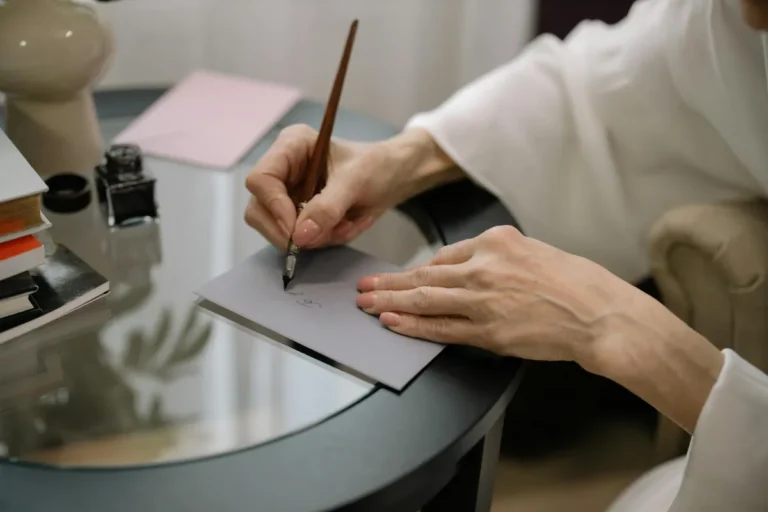
I would like to write, briefly, about the long letter — by which I mean the letter that runs to several pages, that is written by hand or by typewriter on actual paper, that contains the considered correspondence between two adults across the course of months and years, and that constitutes one of the older forms of serious adult relationship between people who do not live in the same place. The long letter was, for several centuries, the principal form of serious adult correspondence in the European tradition. It has, in the past forty years, been more or less lost. I want to describe what has been lost, why the loss matters, and the small partial recovery of the form that I have observed in the past several years among adults who have, for their own reasons, decided to take the older form back up.
What the long letter was
The long letter, in the older sense, is not the same thing as the email. It is not the same thing as the postcard. It is not the same thing as the brief note I have written about elsewhere. The long letter is its own form, with characteristics that the substitutes do not share, and the characteristics are worth setting down.
The long letter runs to four or five or six pages, sometimes more. It is composed at one or two sittings over a period of several days. It is written to a specific person whose presence in the writer's life is sufficient to warrant the time involved in writing it. It is not, in the typical case, about any single subject. It is a portrait of the writer's recent weeks, with such observations and reflections as the writer has been carrying, written for the eye of one reader who knows the writer well enough to receive the portrait fully.
The letter is sent through the postal service. It is received, in the older case, after a delay of some days or weeks. It is read, often in several sittings, by the recipient. It is, in many cases, kept by the recipient. The reply, when it comes, is written in the same register, at the same length, with the same care. The correspondence develops, across the years, into a substantial mutual document that is one of the more remarkable features of the long friendship in the period when the form was generally available.
The long letter was the form by which the great correspondences of the eighteenth and nineteenth and earlier-twentieth centuries were conducted. The published collections of letters from the period are, taken together, one of the major literary documents of the European tradition. The form was not limited to literary figures. It was the form by which any educated adult conducted serious correspondence with the adults in their life who lived elsewhere, and the form was a routine part of adult life across the centuries that it was the standard.
What has been lost
The long letter has been more or less lost over the past four decades, and the loss has accelerated through the period of the email and the text message. The loss is not absolute — there are people who still write long letters, and I will say something about them — but the form is no longer the routine form by which adults of education and means conduct their correspondence across distance.
The substitutes for the long letter are familiar. The email of moderate length serves some of the functions, but not all of them. The text message and the platform message serve other functions. The video call serves still others. The substitutes do, in aggregate, much of what the long letter did, but they do it in a different mode, and the difference is what I want to draw attention to.
The long letter operated in a mode of considered composition that the substitutes do not require. The writer of the long letter sat down at a desk for an hour and composed several pages. The composition was slow, with attention to the sentences. The result was a document of considered substance. The substitutes operate in a mode of brief and unconsidered communication that is appropriate to the medium but that does not produce, on its own, the same kind of document.
The long letter also operated in a mode of patience that the substitutes do not require. The writer composed the letter and then waited for the reply, which came in days or weeks. The waiting was part of the form. The writer was not, in the waiting period, in continuous communication with the recipient. The communication occurred at the scale of the correspondence rather than at the scale of the moment. This produced, in the participants, a particular kind of relationship with one another that was not the relationship of continuous availability.
The long letter also operated, finally, in a mode of permanence that the substitutes do not produce. The letter was a physical object, kept by the recipient. The correspondence accumulated, over the years, into a physical archive that could be reread and that constituted, in itself, a portrait of the relationship across the years. The substitutes produce, at best, the searchable electronic archive, which is not, in my experience, of the same quality as the physical document.
The small partial recovery
I have observed, in the past several years, a small partial recovery of the long letter among the adults I know. The recovery is not large. It is not announced. It is conducted, in most cases, between two adults who have, for their own reasons, decided that they would like to correspond at greater length than the substitutes allow.
The correspondents I know who are doing this are, in general, adults of moderate age who came up in the period in which the long letter was still a recognized form and who have, in the past several years, decided to take the form back up with one or two specific adults in their life. The correspondences are usually conducted at the rate of two or three letters per year per correspondent. The letters are written at the older length. The correspondences accumulate across the years.
The recoveries are private. They are not the subject of the public discourse about correspondence. They are, in nearly every case, between adults who have decided that the form is worth taking back up with one specific other adult who they want to be in this kind of correspondence with. The form is more demanding than the substitutes. The correspondents have decided, in each case, that the additional demand is worth what the form produces.
What the recovered form produces
The recovered form produces several things that the substitutes do not produce, and the things are worth describing for any reader who is considering whether to attempt a recovery of their own.
It produces, first, the considered document. The letter of several pages, composed over several days, is a different kind of document from the email of moderate length. The composition produces a particular quality of writing that the email does not generally produce. The letter is, in most cases, more carefully composed, more attentive to the sentences, more substantive in its observations than the email is.
It produces, second, the deepened relationship between the correspondents. The correspondents who have been writing one another at the older length across several years know one another in a way that the corresponding adults who have been emailing one another at the briefer length do not. The depth is not, on its own, the consequence of the medium; it is the consequence of the considered attention that the medium asks for. The deepened relationship is one of the more striking effects of the form, and it is the principal reason that the correspondents I know who have taken up the recovery are continuing the practice.
It produces, third, the physical archive. The letters accumulate. The archive is held, in most cases, in a folder or a small box that the recipient has set aside for the correspondence. The archive can be reread at intervals. The rereading produces, in the recipient, the small encountered presence of the correspondent's former self that the substitutes do not produce.
Whether to attempt a recovery
The decision to attempt a recovery of the long letter is, properly, a decision that two adults make with one another. The form does not work as a one-sided practice; it requires a reciprocal correspondent who is willing to write at the same length and with the same care. The recovery, in the cases I have observed, has typically begun with one adult writing a letter of the older length to another adult in their life, with the implicit invitation to reply in the same register, and with the recovery proceeding from there.
I would suggest, mildly, that if there is an adult in your life with whom you have, over the years, had a correspondence at the briefer length, and with whom you would like the correspondence to deepen in the way I have been describing, you might consider writing them a letter of the older length and seeing what happens. The downside is small. The upside is one of the small available recoveries of the older adult forms, and the recovery, when it proceeds, is one of the small reliable additions to an adult life that I have encountered in the present period.
The form is older. It has been mostly lost. It is being, in a small way, recovered. The recovery is conducted privately, by adults who have decided that the surrounding alternatives have eroded enough to make the older form worth the effort of taking back up. The form will probably not, on the strength of the small recoveries, return to general use. It will probably continue, in the cases of the adults who have taken it back up, to do the work it has always done, between people who have decided that the work is worth the cost. The decision is, as it has always been, available to anyone who chooses to make it.