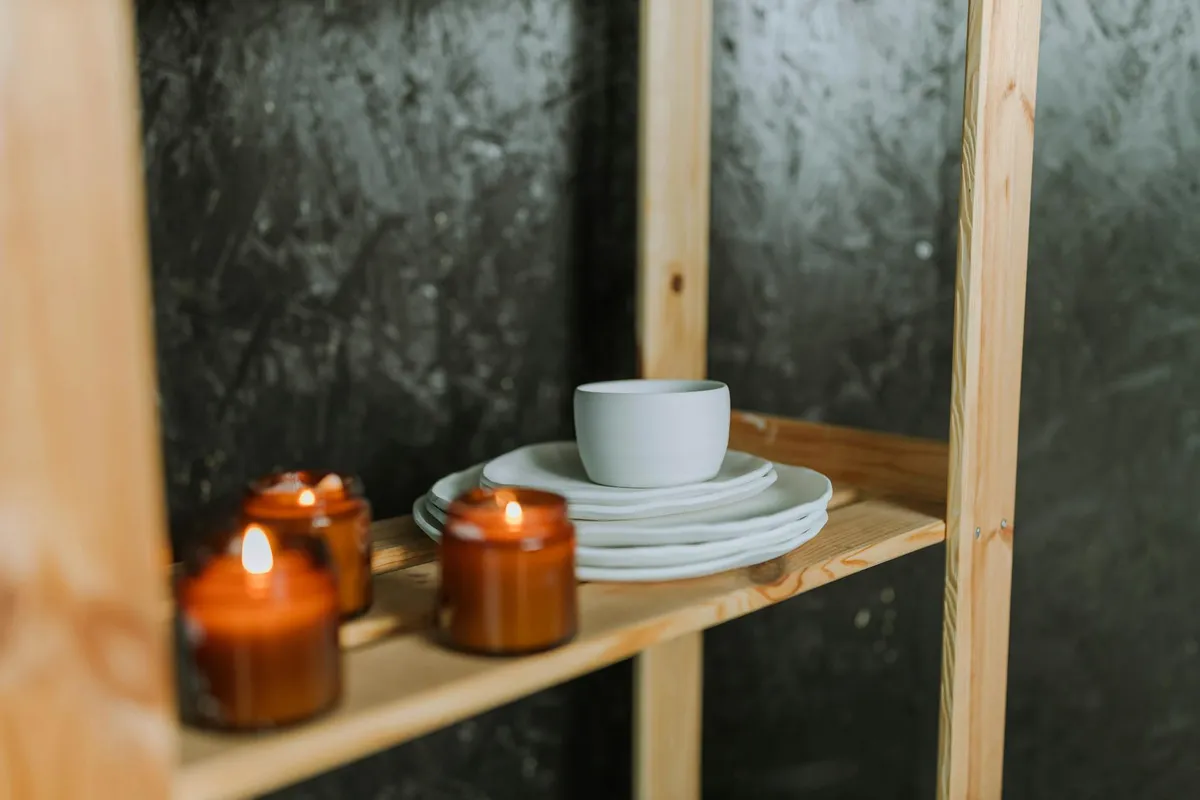
I want to write briefly about the small kitchen of considered objects — the small number of good glasses, good plates, and good knives that an adult living alone or a couple living together can reasonably operate from — and to argue that the case for this kind of kitchen is older and stronger than the contemporary minimalism literature would suggest. The case I want to make is not the minimalist case in the recent meaning of the word. The minimalist case is, in its current form, about visual cleanness and about psychological tidiness. The older case is about something else, and the something else is what I want to recover.
What the small kitchen looks like
I should describe what the small kitchen looks like, in my account, because the description matters for the argument. The small kitchen has, in glassware, perhaps six wine glasses of one shape, six water glasses of another shape, and perhaps a small number of other glasses for specific purposes — a few coupes, a few small glasses for after-dinner drinks. It has, in plates, perhaps eight dinner plates, eight smaller plates, eight bowls. It has, in knives, two or three knives that are sharp and that fit the hand. It has the corresponding small set of cooking pots and pans, perhaps four or five in total, of various sizes. It has the small set of cooking implements — wooden spoons, a ladle, a small grater, a few other things — that are used routinely.
The total inventory is small. It fits, in most apartment kitchens, in a single set of cabinets without crowding. It can be washed by hand in a reasonable time after a meal for several people. It can be replaced, when objects break or wear out, on a moderate budget across the year.
The total inventory is also enough. The kitchen of this kind can produce a meal for two, a meal for four, a small dinner party for six. The kitchen of this kind has, in my experience and in the experience of every adult I know who runs a kitchen of this kind, never been the limiting factor in any meal that I have wanted to produce. The cases in which the kitchen would in principle be inadequate — a dinner party for fifteen, say — are rare enough in normal adult life that they do not, on a properly considered basis, warrant the additional storage and the additional inventory required to accommodate them.
What is gained from the small kitchen
The small kitchen produces several specific goods that are worth setting down.
It produces, first, the daily use of objects that have been chosen with consideration. When the kitchen contains six wine glasses, the six glasses are used every time anyone drinks wine. The glasses become familiar in the way that frequently-used objects become familiar. The shape of the bowl, the weight of the stem, the way the glass sits in the hand — these become known. The relationship with the glasses is the relationship that develops over the thousands of uses, and the developed relationship is one of the small daily goods of the kitchen of this kind.
It produces, second, a much higher quality of object per dollar spent than the kitchen of the larger inventory. The budget that, in a larger kitchen, is distributed across forty glasses of various kinds is concentrated, in the small kitchen, on the six glasses that are actually used. The result is that the small kitchen can afford, on a moderate household budget, glasses that are substantially better than what the larger kitchen typically achieves. The same applies to plates and to knives. The economics of concentration are favorable to quality.
It produces, third, the practical good of a kitchen that is easy to operate. The dishwashing after a dinner party for six is, in the small kitchen, the matter of perhaps thirty minutes of careful work at the sink. The unloading and reloading of the cabinets is, in the small kitchen, fast and unconfused. The cooking itself is, in the small kitchen, organized around the small set of implements that have been chosen to do the cooking. The practical operation is smoother than the practical operation of the larger kitchen, in nearly every respect that matters.
It produces, fourth, the absence of the small daily decision fatigue that the larger kitchen imposes. The adult cooking in a kitchen with two suitable knives does not have to choose among them; the choice is made by which knife is currently clean, and the choice is made in approximately no time. The adult cooking in a kitchen with twelve knives makes a small decision at the start of each cutting task, and the cumulative effect of the small decisions across the year is non-trivial. The small kitchen reduces the decision load, not because there is anything wrong with the decisions, but because the decisions do not, in the typical case, produce different outcomes.
What is given up
I should note what is given up by the small kitchen, because the case has to acknowledge the trade-offs.
The small kitchen cannot accommodate the dinner party for fifteen without supplemental borrowing. The cases in which one wants to serve twelve different cheeses on twelve different plates are not supportable without buying additional plates. The cases in which one wants to serve a meal of seven courses, each with a different glass type, are not supportable without acquiring additional glassware. These are real constraints. They are also constraints that, in the actual life I have led and the actual lives I have observed at close range, occur infrequently enough that they do not, on a properly considered basis, warrant the carrying cost of the additional inventory.
The small kitchen also cannot accommodate the eventuality of breakage without prompt replacement. When a glass breaks in a small kitchen, the small kitchen is short a glass, and the glass needs to be replaced if the original count is to be maintained. The corresponding kitchen with twenty wine glasses can absorb the breakage without immediate replacement. This is a real difference. It is also one that I have not, in practice, found to be a significant problem, because glasses break at a low enough rate that the replacement can be folded into normal household acquisition without difficulty.
Why the principle scales
The principle of the small kitchen of considered objects scales beyond the kitchen, and I want to gesture briefly at how.
The same principle applies to the small wardrobe of considered clothes. The case for the smaller wardrobe of better clothes, used heavily, is structurally similar to the case for the smaller kitchen of better implements, used heavily. The dollars spent are concentrated on items of higher quality. The items are used routinely enough that the relationship with the items develops over the years that they are used. The smaller wardrobe is easier to operate, easier to maintain, easier to think about. The arguments translate.
The same principle applies to the small library of considered books. The case for owning few books, kept and reread, is structurally similar to the case for owning few glasses, kept and used. The smaller library can be afforded in editions of higher quality. The books are present in the room in a way that is visible and accessible. The relationship with the library is the relationship that develops over the rereading.
The same principle applies, more broadly, to the entire inventory of household possessions. The adult who has, over a working life, accumulated the small considered set of objects across the categories of household life is operating a household at a different register from the adult who has accumulated the larger uncurated set. Neither register is morally superior. The smaller register has the operational advantages I have been describing and a particular quality of relationship with the objects that the larger register does not, in my observation, produce.
Why this is not minimalism
I want to repeat, in closing, that the case I am making is not the minimalist case in the recent meaning of the word. The minimalist case is, in its contemporary form, principally about an aesthetic of visual emptiness — about white walls and few objects on the surface and a particular look that has become recognizable in apartment photography of the past fifteen years. The minimalist case has its own merits but is not what I am arguing.
The case I am making is the older case for the considered household — the case for the household whose contents have been chosen with consideration, used heavily, kept across years, and replaced thoughtfully when replacement is needed. The household of this kind can be full of objects or it can be sparse. The visual aesthetic is not the operative variable. The operative variable is the relationship between the inhabitant and the objects, and the relationship is the relationship that develops when objects are used regularly across years.
The principle is, when stated plainly, not new. It is the principle that most adult households operated by in most periods of history, before the production economy made it possible for a household of moderate means to accumulate vastly more objects than the household was going to use. The recovery of the principle is one of the small available corrections to the surrounding environment, and the corrections compound across the categories in which the principle is applied. The household of considered objects is a small available form of the older adult life, and the form has been quietly recovered, in the past decade, by people who have arrived at it through their own observation and who are now operating their kitchens, and their wardrobes, and their other household categories in the older register.
I have no recommendation more specific than that. The next time you have occasion to acquire something for the kitchen, you might consider whether you actually need it or whether the object would simply add to the inventory without changing what the kitchen produces. The next time you have occasion to dispose of something from the kitchen, you might consider whether you would actually miss it. The small accumulated decisions of this kind, over the years of running a household, are one of the small ways in which an adult life can be quietly arranged for the quality of the relationship with the daily objects rather than for the quantity of them.