I would like to write briefly about the morning coffee, made slowly at home, with attention, as a small daily practice. I am not going to recommend a particular method or a particular machine or a particular bean. The piece is not, in that sense, a how-to piece. It is a piece about why the practice has, against the considerable pressure of the present moment, held up better than most of the other small daily rituals that working adults conduct, and why the holding has produced an effect on the rest of the day that is worth taking seriously.
What the morning coffee actually is
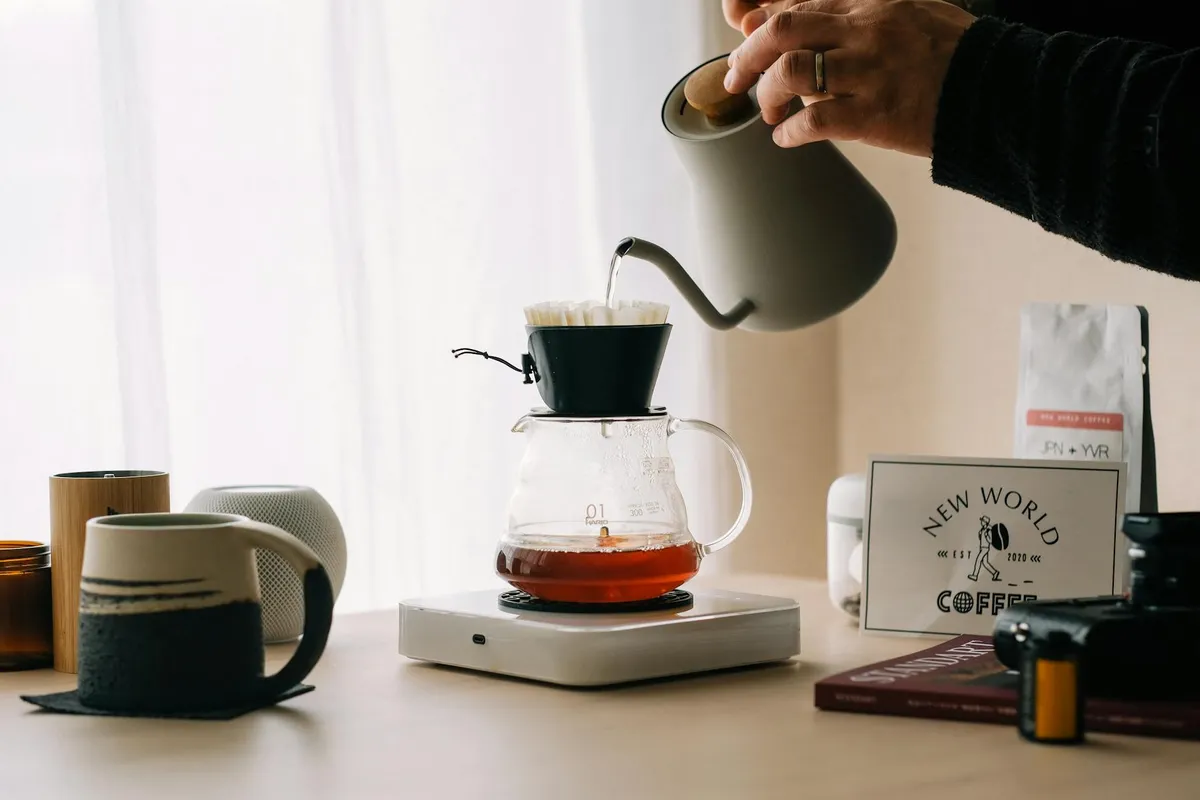
The morning coffee, in the form I am writing about, is a small period of time at the beginning of the day, between roughly six and roughly half past seven, during which an adult who is not yet engaged in any of the day's obligations conducts the small operation of making a cup of coffee with their own hands. The operation involves a kettle, a grinder, a brewing device of whatever kind, a vessel from which to drink. It involves a few minutes of attention to the process. It involves, when it has been done well, a cup of coffee that is sat with for a further few minutes before the day begins.
I want to be careful not to mystify the practice. There is a body of writing about coffee that approaches the subject in a register that I find unhelpful — the register that treats the act of brewing a cup of coffee as a contemplative practice in the spiritual sense, that uses words like ritual and mindfulness, that suggests that the morning coffee is the moral equivalent of a small meditation. The register is not entirely wrong, but it overstates the case in a way that makes the practice harder to recommend to adults who would otherwise be willing to take it up. The morning coffee is, at the level it actually operates, a small physical practice that produces a small pleasant period at the beginning of the day. The case for it can be made without elevating it to a sacrament.
What has happened to the rest of the morning
The case for the morning coffee is best made against the background of what has happened to the rest of the morning, in 2026, for most working adults. The morning has become, in the period running roughly from the rise of the smartphone to the present, a particular kind of compressed and consumed time. The phone is the first object encountered by most adults after they have opened their eyes. The first sensory inputs of the day are the inputs of the screen — the messages that have accumulated, the news that has been delivered, the small notifications that have been waiting. The morning, before it has begun in any meaningful sense, has already been colonized by the inputs that will dominate the rest of the day.
The effect of this on the texture of the day is substantial. The adult who has begun the day with the screen has begun the day in a particular reactive mode that is difficult to leave once it has been established. The attention has been fragmented before it has been collected. The mood has been shaped by inputs that the adult has not chosen. The small period of unstructured time at the beginning of the day, which used to be the period at which most adults assembled their attention for the day ahead, has been folded into the same mode that dominates the working hours.
This is not a new observation, and I will not labor it. The point is that the morning coffee, made slowly at home, with attention, has become — almost by default — the practice that occupies the space that the screen would otherwise occupy. The case for the coffee is, at this level, partly a case against the alternative use of the same minutes.
What the practice produces
What the practice produces, in adults who have kept it for some period, is a particular quality of beginning to the day that is not produced by any other available routine that I have observed in myself or in the friends and colleagues whose practices I have seen at close range. The quality has several components.
It produces a small period of physical attention to a non-screen object. The hands are occupied with the kettle, the grinder, the brewing apparatus. The attention is directed to the steady operation of the small machine. The mind is engaged, lightly, in the small decisions of the brewing — the temperature, the timing, the small adjustments of method. This kind of attention is restorative in a way that the screen attention is not. The reasons are not mysterious. The morning coffee operates in the mode that human attention has been operating in for most of its history, and the restorative quality of that mode is one of the small recoverable goods of the period.
It produces, also, a small period of time in which nothing is being demanded of the adult. The brewing takes the time it takes. The cup is drunk at the pace it is drunk. There is no schedule that the practice serves. The small unhurried period at the beginning of the day is, for most adults who keep the practice, the only unhurried period of the day, and the rest of the day proceeds differently because the period has been there.
It produces, finally, a particular kind of small daily satisfaction that is not produced by any other comparable practice. The cup of coffee, when it has been made well, is a small definite good in the world that the adult has produced with their own hands at the beginning of the day. The satisfaction is modest. It is also reliable, in a way that most of the satisfactions of working life are not. The adult who has made themselves a good cup of coffee has accomplished a small thing that they can know they have accomplished, and the small accumulated knowledge of these small accomplishments is part of how a working life is made.
Why the practice has held
The morning coffee has held up, in the cohort of adults I observe, better than most of the other small daily practices that working adults have attempted to keep in the present period. The practice has survived the smartphone, the productivity culture, the work-from-home rearrangement, the period when commuting collapsed and the morning lost its structure. The practice has held because the practice produces, on a daily basis, an effect that the adult can feel directly. The adult who keeps the practice notices, when they skip it, that the rest of the day is measurably worse. The adult who skips the practice often does not have a good substitute that produces the same effect.
The holding has not been universal. The practice has been displaced, in many adult lives, by the convenience of the cafe coffee on the way to the train or by the office machine that produces something passable without effort. These substitutes have their own merits but they do not produce the effect I have been describing. The effect requires the practice to happen at home, with attention, in the unhurried period before the day begins.
A small recommendation
I will close with a small recommendation. If you do not currently make your morning coffee at home, with attention, in the period I have been describing, I would suggest that you might consider doing so for a month and see what happens. The investment required is small. You will need a kettle, which you probably have. You will need a grinder, which is a one-time purchase. You will need a brewing device, of which there are several adequate options at modest prices. You will need beans, which are widely available. You will need fifteen minutes in the morning that you currently spend on the phone or that you currently sleep through.
The effect, in my experience and in the experience of the friends I have recommended the practice to over the years, is one of the small reliable improvements to the texture of an ordinary working life that has, in the present moment, become available almost by accident, because the surrounding alternatives have eroded enough that the older practice produces a clearer effect than it did when it was just one option among many. The morning coffee is one of the few daily practices that has become more valuable in the past decade rather than less. I would recommend it without qualification.