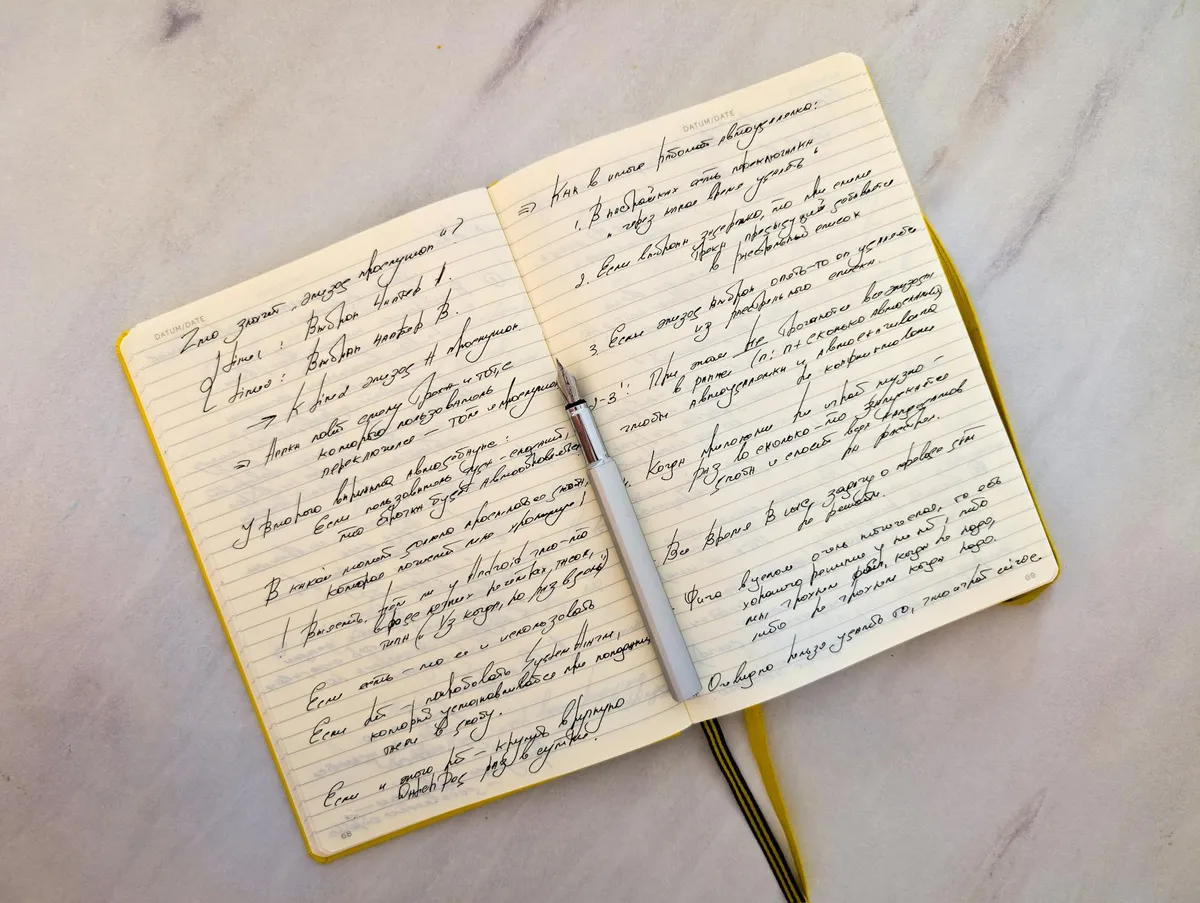
I would like to make a brief case for the small daily habit of sitting down to write three sentences in a notebook, by hand, about whatever has happened that day. The case is one I have been making to friends in private conversation for some years, and several of them have taken up the practice and reported back, in terms that have surprised even me, that the practice has been one of the better small additions to their working life that they have made in recent memory. The case is worth setting down in writing because the practice is one of the older practices that has been more or less forgotten in the present period, and because the surrounding circumstances of 2026 have made the practice more useful than it would have been at most earlier points.
The practice is not a journal in the elaborate sense. It is not a diary in the literary sense. It is not a gratitude exercise in the wellness-industry sense. It is a small daily commitment to write three sentences, by hand, in a notebook, about whatever the day has contained. The three sentences may be about the day's work, about a conversation, about an observation, about a small frustration, about a small pleasure. The form is open. The discipline is in the doing of it, daily, for a long enough period that the accumulated record begins to do its work.
What the three sentences are not
I want to be clear at the outset about what the practice is not, because the field of comparable practices has been thoroughly colonized in recent years by versions that I think do not work and that have given the underlying practice a slight reputational injury.
The three sentences are not a gratitude journal. The gratitude journal is the practice of writing down, daily, three things one is grateful for. The practice has some merits in the right circumstances, but it has been promoted past the point of usefulness by the wellness industry, and the practice has the particular weakness that it is structurally limited to a small category of acceptable contents. The three sentences should be able to be about anything — a frustration, an irritation, a moment of confusion — without the practice generating any self-judgment about whether the content is the right content. Most days are not entirely positive. The practice should be able to honestly record this.
The three sentences are not, equally, a productivity log. The productivity log is the practice of recording, daily, what one has accomplished. This practice has some merits if the writer is in a specific situation that requires it, but it is also not what I am recommending. The three sentences should be able to be about something other than accomplishment, and they should be allowed to be about something other than accomplishment without the practice generating the implication that the day has therefore been wasted.
The three sentences are not a self-improvement practice. The practice does not exist to make the writer a better person, a more efficient person, a more grounded person. The practice exists to produce a daily record of attention to one's own life, of a kind that almost nothing in the current default environment otherwise produces.
What the three sentences do produce
The practice produces, over a period of months and years, several specific effects that are worth describing.
It produces, first, a daily moment of attention. The act of sitting down at a notebook for the three or four minutes the practice requires is a daily moment in which the writer is not doing anything else — not consuming, not producing for an audience, not communicating with another person — and is instead engaged in the quiet operation of registering, in language, what the day has contained. The daily moment is small. It is also, in the cohort of adults I know who have kept the practice, one of the few daily moments of the relevant kind, and the cumulative effect of having one such moment per day is more substantial than it sounds.
It produces, second, a record. The record accumulates over months and years into a substantial document. The document is not, in most cases, particularly literary. It is a record of the days as they were. The record can be read back, at intervals of a year or more, and the reading back produces a particular kind of perspective on one's own life that is not available through any other practice I have encountered. The adult who has kept a notebook for ten years can read what they wrote on a date in the past and can encounter their own former self in a way that no photograph or memory or document otherwise produces.
It produces, third, a small daily practice of attention to language. The three sentences should be composed with some attention. They should be sentences rather than fragments. They should mean what the writer wants them to mean. The daily practice of composing three sentences for one's own consumption is one of the small ways that an adult's relationship with their own use of language can be maintained, and the maintenance has effects on the writer's communication in other contexts that are easy to underestimate.
It produces, fourth, a small daily check on the question of what one is actually doing. The practice of writing three sentences about the day requires the writer, briefly, to consider what the day actually contained. The consideration is brief. It is also, for most adults in 2026, one of the few moments in the day at which this kind of consideration occurs at all. The daily check is not, as the wellness industry sometimes presents it, an exercise in self-reflection. It is a small operational matter of looking at what is happening in one's own life with enough attention to write three sentences about it.
The mechanics
The mechanics of the practice are simple, and I will set them out briefly.
Acquire a notebook of moderate size, hardbound, with paper that is pleasant to write on. The exact specifications are not important. The notebook should be one that you will be willing to write in daily for a year. Many small notebooks are produced for this kind of purpose; the choice among them is a matter of taste rather than of substance.
Acquire a pen that produces a line you do not mind. Most pens of any quality are adequate. A fountain pen is correct but is not necessary.
Place the notebook somewhere in the apartment that you will encounter daily and that has a chair you can sit at for three minutes. The kitchen table, the desk, the bedside. The location should be one where you can perform the practice without interruption.
Decide on a time. The end of the day, before going to bed, is the most common time and the one that fits the practice best. The early morning, before the day begins, is also possible but tends to produce sentences about the prior day, which is fine but slightly less integrated than the end-of-day version.
Sit down. Write three sentences. The sentences can be about anything. They can be brief or moderately substantial. They should be composed, not jotted. They should be sentences you would not be embarrassed to read in a year.
Date the entry. Close the notebook. Do not, in general, reread the entry the same week. The practice operates partly through the slight distance that develops between the writing and any subsequent reading.
The first month and after
The first month of the practice is, for most adults who take it up, mildly difficult in a way that is not what the adult expected. The difficulty is not in the writing itself, which is brief. The difficulty is in the daily commitment. Most adults discover, in the first month, that they have not had a daily commitment of this kind for some long while, and that the small discipline of meeting it every day requires some adjustment.
The second month is generally easier. By the second month, the practice has become part of the daily structure, and the act of sitting down at the notebook is no longer a question that has to be decided each evening. It is a thing that happens.
By the sixth month, the accumulated record is large enough to read back over with meaningful interest. The adult who has kept the practice for six months can read what they wrote in the first month and can encounter the version of themselves who was just starting the practice, with the small benefit of perspective that the time has produced. This is the point at which most of the adults I know who have taken up the practice begin to understand what the practice is doing.
By the second year, the practice has produced a document of substantial value. The document is the record of two years of the writer's life, in the writer's own hand, in three-sentence increments. The document is not literary. It is also not anything one can produce through any faster means. It is the slow accumulation of daily attention to one's own life, and the cumulative effect of having such a document is among the small reliable benefits of the practice.
Why this is worth your time
The case for the practice, in 2026, is that the daily attention to one's own life is more thoroughly displaced by other inputs than it has been at most prior periods, and that the small intentional practice of producing three sentences a day operates as a small corrective against the displacement. The three minutes the practice requires are minutes that would otherwise be spent on the phone or on the screen or on the small reactive functions of the working day. The minutes produce, in their place, a small intentional act of attention to one's own life.
The act compounds. The compounding is not visible day to day. It is visible at the scale of months and years. The adult who has kept the practice for several years has a particular relationship with their own life — a relationship of accumulated attention, of small daily registration, of the steady record-keeping that adults used to keep before the surrounding environment made it harder to keep. The relationship is one of the small assets of an adult life that, once acquired, is not easily lost.
I would suggest, in closing, that you might consider taking up the practice for the remainder of the year, see what happens, and read what you have written when the year is over. The investment is small. The downside is negligible. The upside is one of the small reliable benefits to an adult life that the present moment has made more available rather than less, by thinning out the surrounding alternatives. The notebook is waiting. The three sentences will write themselves once you sit down at it.